
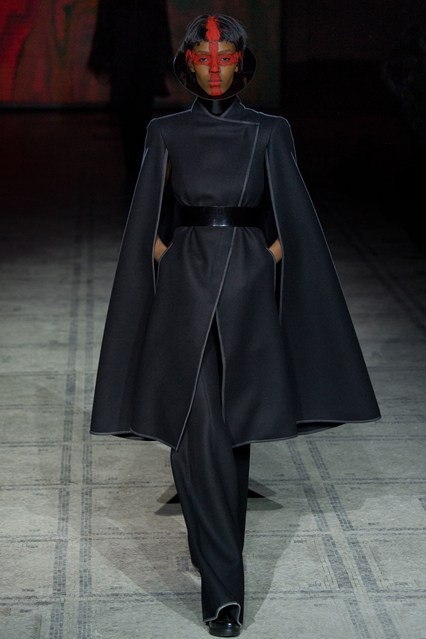
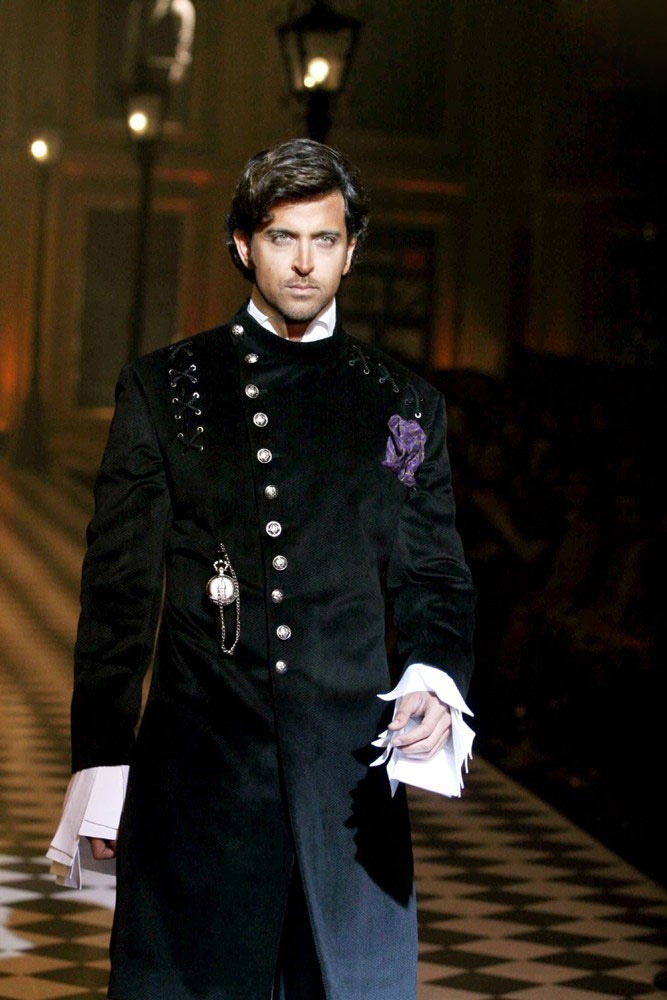
Gareth Pugh FW15

He found the world beautiful, when he was finally permitted to step into it. His family were pureblood, after a fashion. Descended of the Gaunts who claimed descent of Slytherin, who in turn, it was said, claimed descent of still older lines, back into time immemorial.
He had been raised in a house kept clean by house elves, been served meals from tables already set with plates and food, had new clothes neatly placed away in his rooms, cleaned up from whatever he left on the floor.
From what he ascertained at school this was not far off from what some rich muggles lived like, though they had human servants, not elves.
But oh, when he got his letter, and he was allowed to be fully inducted into the wonders of the magical world. His family hadn’t worried much – they’d heard him hissing to snakes – but he had been, little Dirk Treason, he’d wondered if he’d had magic enough. It had been an odd choice of his family’s, to keep much of magic from him, until it was known, for certain, that he had magic enough for Hogwarts.
Diagon was bright and colourful to him, Knockturn dark and mysterious, each new alley and neighbourhood he learned of fantastic. He thought – he believed, even – that the magical world was perfect and whole and entirely untouchable, unchangeable.
Then he went to school, and one by one, his illusions shattered.




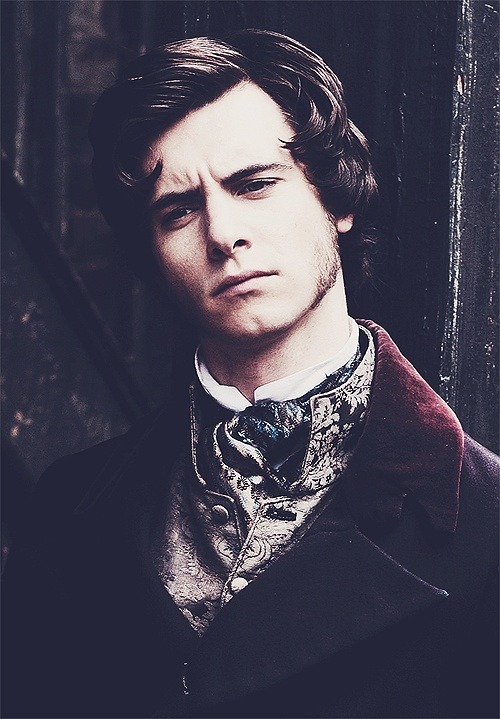
“Captured by old Nott, my grandfather in Knockturn, in his prime and at the cutting edge of society, really,” says your host, “People do talk about him, but those were fanatical days; Grindelwald had not yet fallen, and everyone had what would now be deemed an unpopular opinion, not just grandfather. And there, on the wall, the portraits – meant to echo each-other – of his father, who was on the Wizengamot, and of mine; they have the general look of the family, as you can see. Great-grandfather of course is also somewhat disliked today; they say he was monstrously unfair, but if truly you read his opinions I think this is exaggerated. One could only do so much before the great Muggle-lovers’ reforms swept in, and he did not believe in judge-made law. I agree. I do think it’s a bit like overstepping one’s station, don’t you?” Here he gives a small laugh. “We have never liked oversteppers, I must say…”
This is an understatement, so you do not comment.
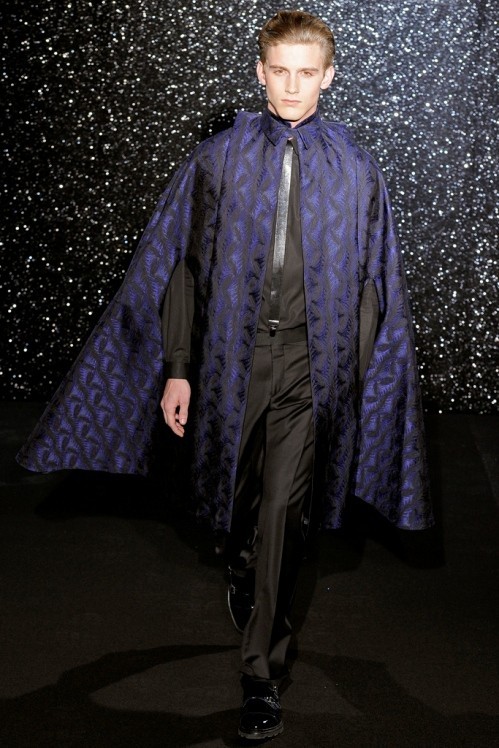
“…of course you’ll note that my father is in the cut he wore back then, when there was a great mania for traditional wizarding regalia and such. When you are a family like ours, you do tend towards tradition. Other people treat it as a bogeyman. Unfairly, I think. But then again there is my son. Here’s his photograph; the very image of my father, only in a great flapping Muggle kind of belted cloak. Very embarrassing, but my wife had Dippy take the picture. A very devoted mother, my wife. It’s a shame we don’t have the women’s portraits in here; they far outstripped the men, I think. Now here–”
“But wait,” you interject, suddenly noticing something very odd, “Where are you? I don’t see your picture anywhere.”
“Oh,” your host says, with a kind of only barely-concealed dread, “Oh. I’m afraid we generally sit for portraits at eighteen, and my eighteenth year was not a portrait-painting sort of time. And of course I’m by far the least prepossessing in the line. A pointed chin, you know.”
And then he sweeps you out of the very imposing, cold room (which looks terribly old, but which they say had to be rebuilt after the war), and a house-elf appears at your elbow to make sure you don’t try to turn back for another glimpse, and there is your host’s mother, distracting you with light, canny talk; and out of the corner of your eye you can see your host looking relieved. Is it because he no longer has to discuss this with you? He is a renowned coward, after all. Far too much of a coward to face the reality of his family, you think. But then you turn your mind back to all those proud brows and haughty chins, and begin to wonder if, really, he is relieved that there is no picture to complete the chain, nothing to demonstrate he may echo his forefathers, no voice which might say, “Oh yes, there is old Draco, who is exactly like the rest of them, really; note how much like his father around the eyes.”
Perhaps the relief is because he would not like to be like them at all.
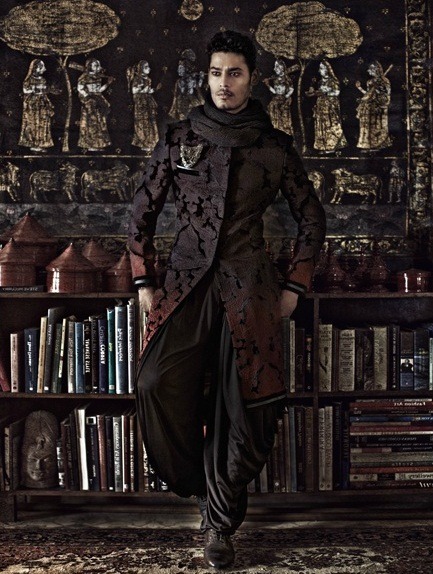
“Tell me what you think,” said Harry Potter. He was ready to give up and beg off dinner. All would-be biographers bothered him. They never got the story right.
“Truly?” said his dinner guest. The dinner guest seemed bored. He glanced all around at the tapestries on the walls, the many souvenirs these Weasley-Delacours had brought from abroad. He could not tell if he hated them or not. Weasley was an avid collector of the foreign, which was slightly nauseating. But he was also a friend – they had met inside a pyramid, running from the same curse, and though they had competed for the same priceless treasure he had won it. But he’d surrendered it to Weasley for a story; Weasley had said, “Let me tell you of the Damia’s cavern…”
Harry Potter was beginning to look impatient.
“I met a wizard on the trip over, looking harassed, waving off Ministry Passport Regulation, terribly upset because his luggage was un-shrinking itself. A prank, he said—”
“What does this have to do with—“ Harry Potter said.
“Listen,” said the dinner guest. “He said he’d won the enmity of some persons at school. I said, ‘Tell me more.’ I love a good story. He said, ‘It happened like this. I was in my common room, and in came the girl I adored at the time. Though, perhaps not adored. She was a nag, and her nose turned up too much, but my parents liked her. But someone had gone and given her a pug’s whiskers, which was cruel. I said, “Who did this, Pansy?” She said, “There I was, returning my corrected essay to that complete imbecile, Lupin–”’”
“He wasn’t a–” Potter said, furious.
“Listen,” said the dinner guest. “’”There I was returning my essay, which you know he wanted to be all about how we should hug and cuddle trolls and make love to hags; he’s so enamored of all that filth,” said the girl I somewhat liked at the time. “He’s such a champion of the half-breed—“ “Like all of them,” I put in. My people never did like half-breeds. And also Pansy was alright. Not my favorite person. But alright. “Yes,” said she, “And I told him so, and in came those horrible Weasley twins—“ And Pansy did not need to say more,’ said the fellow with the luggage. ‘Pansy did not need to say more. I knew right away where that was going.’ And as his luggage attempted to eat him, he explained that these twins were awful pranksters fully capable of hexing everything one owned, even if one owned quite a lot, and on that day he earned their hatred very fully. I will not bore you with the details of how—“
“No, please do,” said Harry Potter. “I think I’m going to like this story.”
“Well, what interests me, really, are the twins,” said the dinner guest. “I came upon a shop with their name while I was attempting to find my hotel. I bumped into a young fellow with odd green hair outside it. He said, ‘’Scuse me. James and I have got to get these new exploding quills. It’s a matter of life and death.’ I said, ‘Djinn’s drawers. Really?’ He looked somewhat shamefaced. ‘Oh, well. I suppose not. Gran says I shouldn’t use language like that. I mean, nowadays nothing’s really a matter of life and death. Certainly not some schoolboy prank.’ But I said, ‘Now, times must have changed. Just this morning I heard of an enmity that began at your Hogwarts and continues to this day, and—‘ ‘Well,’ interjected the fellow, ‘See, Hogwarts was different, once. It was a real battleground! Why, Mr. Weasley’s brother laid down his life there, and, and—‘ ‘And?’ I prompted. ‘And my mum and dad!’ he said stoutly. But he would not go on, and I would not press, as it was rude. Still, I got the story of these heroes out of— Well. I’m going on too long, I think.”
“No!” said Harry Potter. “I want to know who was talking about them! Tell me!”
“You know the fellow,” said his dinner guest. “Tall, red-haired. Weasley’s brother. He met me at the Apparition point. He seemed upset, possibly in a rush. I said, ‘Friend, I can see you work for the MLE. It is a trying profession. Do what you must, and I will wait.’ ‘Hang on,’ he said, looking guilty. ‘It’s not that. It’s the date. Anniversary of the Battle of Hogwarts. Now, the person you’ve got to hear it from is Dennis Creevey, who lost his brother. So did I, but Dennis is a better storyteller. And the way he told it to me is that while I was off camping and having an awful time, the time they were having at the school was worse. “Ron,” he said, “Ron, You and I both? We don’t what it was like under Snape.” Alright, to give Snape his due, he was working undercover, but he was a real arse, so nothing Dennis said really shocked me. “Thing is, Ron,” Dennis said, “Your sister probably keeps it from you, but the truth is that when we saw them again, the rest of the DA was all ready to die by the time the Battle rolled around. Dying couldn’t have made it worse. See, people just tell the story of that one day. But what they miss is the lead up to it. ‘Dennis!’ Eloise Midgen said when she saw me, before I went on the run. ‘Dennis! There’s been so much death. Mad-Eye Moody’s gone, did you hear.’ And she repeated it when I saw her a year later. Mad-Eye had been gone for a while, but she’d fixated on it. People do, when there’s a lot of awfulness. They pick one point and keep to that. They can’t handle it all,” said Dennis. Wait. Merlin’s balls, but I’m muddling the story,’ Weasley said.”
“Not at all,” said Harry Potter.
“That’s what I said to Weasley,” said the dinner guest.
But then he didn’t say anything else after that. He cut into his meal. Chewed. Looked thoughtful. Swallowed.
“Well, go on!” said Harry Potter, “I’m sure you’ve heard of what happened at the school all that year, and the people who died for us, and the build up, how even as kids all that hatred was there, and that death, and—”
“That story should be told,” said his dinner guest.
“Yes,” said Harry Potter, “Not my story, but—“
“But the story of a whole society, of a world,” said his dinner guest.
“Yes,” said Harry Potter. “Yes.”
And this was how Mr. Shahryar, he who could find – within a single tale – the countless other tales that gave it a foundation (for they say he is son of the son of the son of the son of Scheherazade herself), was invited to pen Harry Potter’s biography.
Only not Harry’s, not really. Everyone’s. One couldn’t tell the story without the buildup, the ones who’d died, the small hatreds of children, the great deaths of the men and women they became–
Well. One could. But why on earth would one want to?

 MissWriteress